





Fred Luddy Had It Right. It Just Took AI to Prove It.
Platform Copilot transforms ServiceNow by enabling business users to build workflows using AI. Discover how Percy finally delivers Fred Luddy’s original vision. Platform Copilot is an AI-powered assistant for ServiceNow that enables business users to create, modify and automate workflows using natural language while maintaining enterprise governance.
How Platform Copilot Delivers Fred Luddy’s Original Vision
By Jeff Vosburgh, Chief Business Development Officer, Dyna Software
Fred Luddy founded ServiceNow in 2004 with a deceptively simple idea. He wanted to build a platform where business users (not developers) could build the workflows and automations that ran their organizations. Describe what you need, the platform does the rest. Fast, accessible, powerful. A truly modern enterprise operating system built for the people who actually run businesses.
It was a brilliant vision. And for twenty years, it largely went unrealized.
What Happened to Fred’s Vision?
ServiceNow succeeded beyond almost anyone’s expectations. Today it is one of the most widely deployed enterprise platforms on the planet, running IT operations, HR, customer service, security, and supply chain for thousands of organizations worldwide. By nearly every measure, it is a triumph.
But somewhere along the way, the platform that was supposed to empower business users became one that required armies of specialists to operate, along with certifications, multi-month implementation programs, dedicated platform teams, and services engagements that routinely run into the millions of dollars. It created a cottage industry of partners, integrators, and consultants whose entire value proposition is navigating complexity that, according to the original vision, should never have existed.
Ask anyone who has tried to make a meaningful change to their ServiceNow environment without a developer in the room. They know the gap between what ServiceNow promises and what it actually delivers to a business user is enormous. Not because the platform is bad. Because it is vast, sophisticated, and deeply technical in ways that require expertise most organizations cannot afford to keep in-house.
The vision was right, but it was the execution that left business users behind.
The Question Nobody Could Answer
For years, the ServiceNow industry wrestled with an unanswerable question: how do you give a business analyst or an IT operations manager the ability to act directly on the platform, without handing them a development environment they cannot navigate and without routing every request through a backlog that takes weeks to clear?
Workflow builders helped, but had limits. Low-code tools helped, but still required training. Documentation improved, but the platform kept growing faster than any individual could absorb.
The honest answer was: “You cannot.” Not without a fundamentally different interface between the person and the platform.
That interface now exists. It is called Platform Copilot.
Percy: The AI Teammate Who Speaks ServiceNow Fluently
Platform Copilot is built around an AI agent named Percy. Percy is not a chatbot, search tool, or even a help assistant that points you to documentation. Percy is an agent that understands ServiceNow at a structural level (schemas, update sets, flows, scripts, assignment rules, ATF tests, the whole architecture) and it takes instructions in plain English.
Here is what that looks like in practice.
A business analyst opens Platform Copilot and types: “Add a new field to the incident form for customer impact, and update the assignment rule so high-impact tickets route to the priority queue.”
Percy reads that. It reasons about the instance. It proposes a clear, step-by-step plan showing exactly what will change, which tables are involved, and what the experience will look like afterward, including a live visual preview. The analyst reviews the plan. If it looks right, one click executes it. If something needs adjusting, they type the change in natural language: “Actually, only apply this to the North America business unit.” Percy adjusts the plan. Another click, and it is done.
Every change is captured in a pinned update set that is reviewable and promotable to higher environments exactly the way a platform team would expect. Every action is logged. Every change is reversible. Nothing happens without explicit human approval.
This Is Fred’s Vision. Finally.
What Percy has done is collapse the gap between business intent and ServiceNow execution. The layer of specialist expertise that used to sit between a person who had a need and the platform that could fulfill it has been replaced by a conversation.
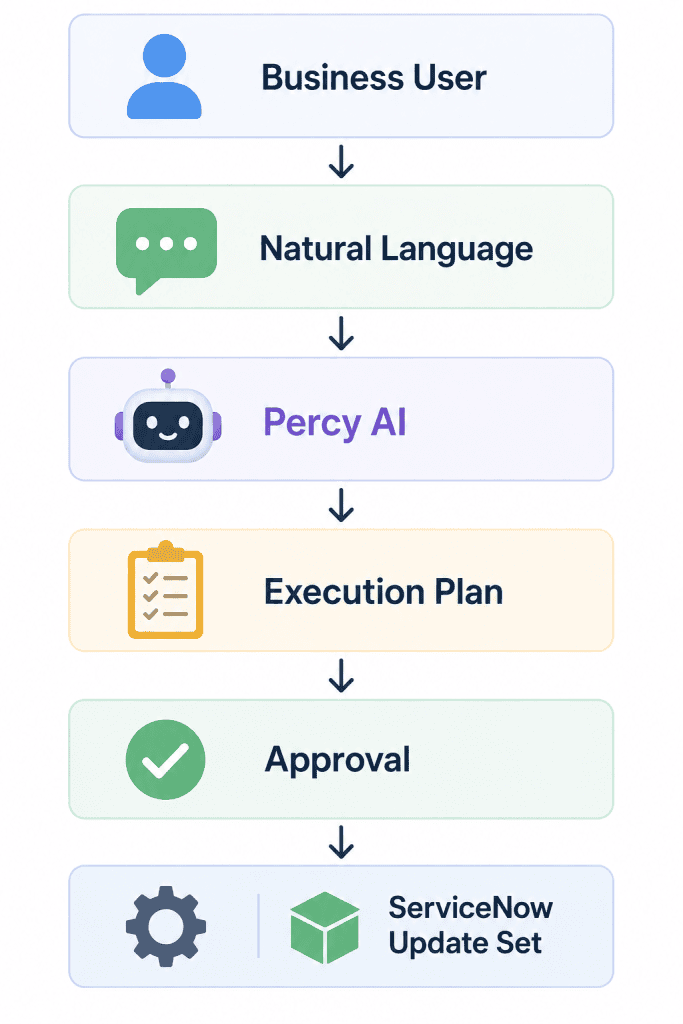
That is not an incremental improvement. It is a structural reimagining of how ServiceNow is used.
Think about what this means for the speed of innovation inside an organization. Ideas that used to sit in a backlog for weeks can be explored and tested in a single afternoon. Processes that required a formal project to modify can be iterated on in real time by the people who understand them best. The business users who live inside these workflows every day (who know exactly what is broken, what slows them down, what would make them more effective) now have the ability to act directly.
And for organizations relying on external partners or managed service providers for their ServiceNow development, the economics change fundamentally. Not because the expertise of a skilled platform team becomes irrelevant (it does not) or governance remains in place for every change Percy makes. They change because the volume of requests that require that expertise drops dramatically, and the requests that remain are the ones that actually benefit from deep human judgment.
Safe, Transparent, and Built for the Enterprise
A fair question: if Percy can make changes to a ServiceNow instance, what stops it from making the wrong ones?
The answer is: layered human control, by design.
Percy always proposes before it acts. Every plan is reviewable. Every execution requires explicit approval. Sensitive tables and fields are off-limits regardless of what anyone asks. Changes are grouped in update sets that can be rolled back as a single unit. A full audit trail captures every plan, every decision, every approval, and every outcome. Your data never trains AI models. Multiple team members can watch a Percy session live, and organizational governance gates remain in place throughout.
Percy was built to accelerate skilled work, not to replace the judgment that makes organizations run well.
The Wait Is Over
Fred Luddy was right back in 2004. Business users should be able to build and adapt the workflows that run their organizations. The platform should serve the people closest to the work, not require them to route every idea through a specialist bottleneck.
Platform Copilot makes that real. For the first time, a business analyst, an IT operations lead, or a project manager can sit down with their ServiceNow environment and simply describe what they need. The platform builds it. They review it. They approve it. It ships.
That is the vision. And it is available right now.