




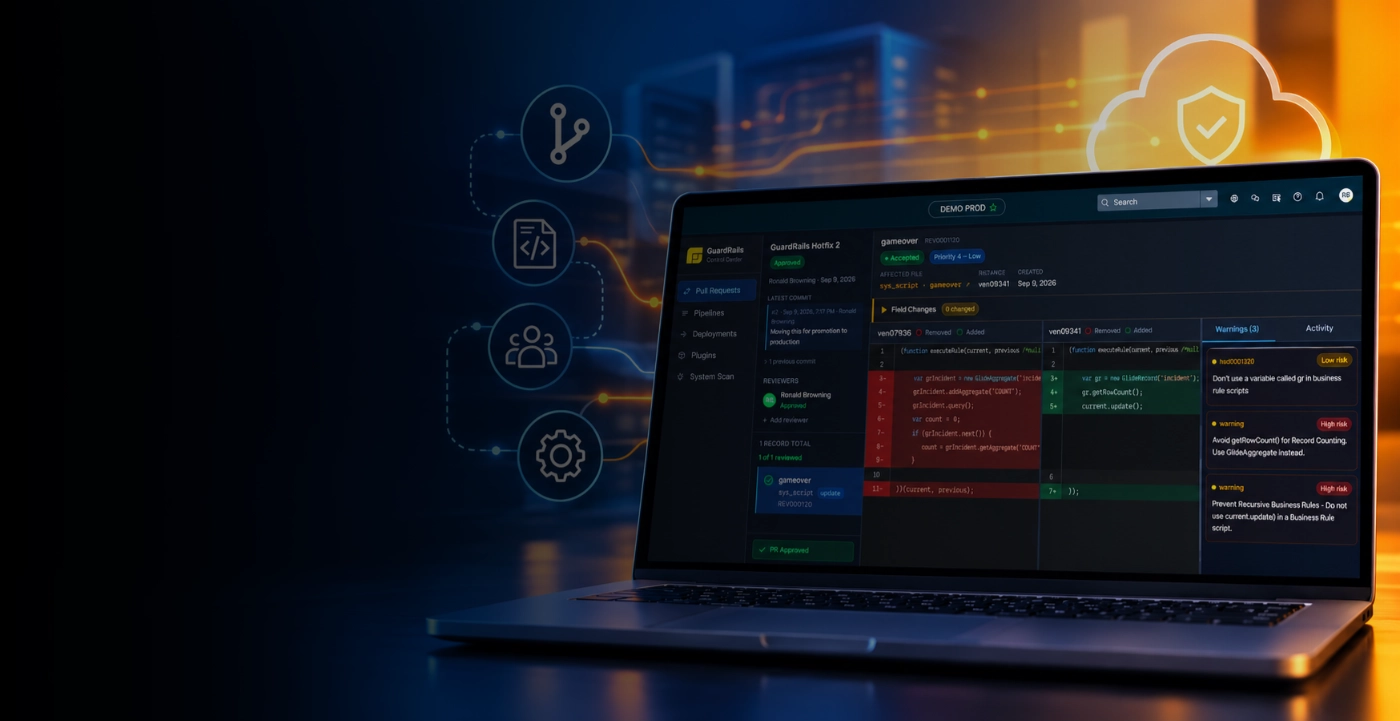
ServiceNow Platform Governance and Continuous Compliance A Framework for Governing ServiceNow Development and Compliance
Summary
A practical guide to ServiceNow platform governance, continuous compliance, source control, release traceability, audit readiness, and AI governance.
Introduction to Continuous Compliance Governance
Organizations rely on the ServiceNow platform to support business-critical workflows across IT, security, customer service, financial services, healthcare, telecommunications, life sciences, and other regulated environments. At the same time, development teams are being asked to deliver more applications, integrations, automations, and platform changes at increasing speed.
AI-assisted development and AI agents are accelerating that change even further.
As the role of the platform expands, an urgent governance question begins to emerge: How can organizations ensure that changes to ServiceNow are properly controlled, and demonstrate that those controls were consistently followed?
Traditional governance models often rely on documented procedures, manual approvals, periodic reviews, and people following established processes. Those practices remain important, but they become increasingly difficult to enforce consistently as development volume, platform complexity, and delivery velocity increase.
Modern ServiceNow governance therefore requires more than having policies and controls.
It requires demonstrable governance, which is the ability to enforce appropriate controls throughout the development and release lifecycle, maintain traceability, and produce reliable evidence that those controls operated as intended.
That is the foundation of continuous compliance governance.
What Is ServiceNow Platform Governance?
ServiceNow platform governance is the framework of controls, processes, technologies, and accountability mechanisms used to govern how applications and platform changes are developed, reviewed, approved, tested, released, and maintained.
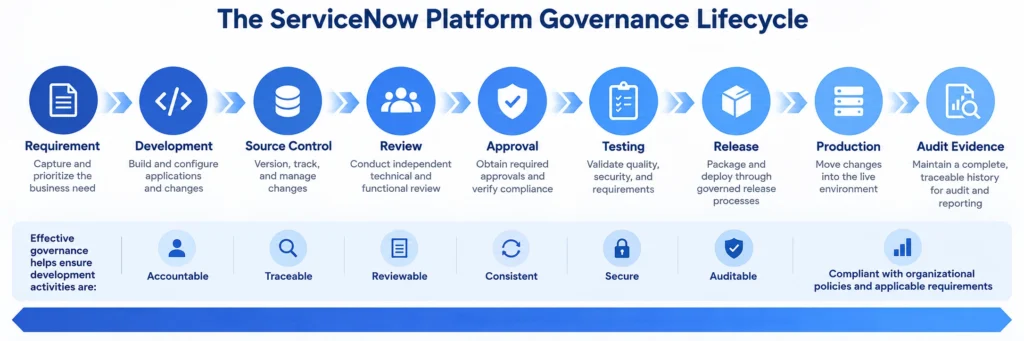
Effective ServiceNow platform governance helps ensure that development activities are:
- Accountable
- Traceable
- Reviewable
- Consistent
- Secure
- Auditable
- Compliance with organizational policies and applicable requirements
For development governance, the lifecycle may extend from the original business requirement through development and source control to review, approval, testing, release, and ultimately production.
A governed lifecycle therefore creates a connected chain:
By taking this approach, organizations can establish appropriate controls over platform changes while maintaining enough evidence and traceability to demonstrate that those controls were followed.
ServiceNow GRC vs. ServiceNow Platform Governance
ServiceNow governance can mean different things depending on context.
ServiceNow’s own Governance, Risk, and Compliance (GRC) and Integrated Risk Management (IRM) capabilities help organizations manage enterprise risks, policies, controls, compliance requirements, issues, and related governance activities.
However, ServiceNow platform governance addresses a different but complementary challenge: governance of the ServiceNow platform itself.
It addresses important aspects such as who is allowed to make code changes? Who reviewed or approved them? and many other critical steps in the development lifecycle.
An organization may therefore use ServiceNow to manage enterprise compliance while still needing appropriate governance over how ServiceNow itself is developed and changed.
This distinction becomes especially important when ServiceNow supports regulated, financially significant, security-sensitive, or otherwise business-critical processes.
Why ServiceNow Development Creates a Compliance Governance Challenge
Organizations operating in regulated industries are often required to demonstrate control over code changes to systems supporting important business processes.
ServiceNow development may therefore become part of the compliance environment when applications, configurations, integrations, workflows, or automations can affect regulated or business-critical processes.
The challenge is not simply whether governance policies exist.
It is whether the organization can demonstrate that required controls operated consistently.
For any significant production change, an auditor, risk professional, platform owner, or compliance leader may reasonably need to determine:
- Who made the change?
- What changed?
- Why was it changed?
- What requirement or authorized work initiated it?
- Who reviewed it?
- Who approved it?
- What testing was performed?
- Who deployed it?
- What reached production?
- Can the complete history be reconstructed?
This exposes an important distinction between having controls and demonstrating control effectiveness.
- A policy requiring independent review does not by itself demonstrate that every applicable production change received independent review.
- A change-management process does not necessarily demonstrate that every production deployment can be traced to an authorized change.
- And the existence of source control does not necessarily demonstrate that every relevant production change passed through source control.
Compliance governance therefore depends on more than documented procedures. It depends on the ability to govern, enforce, trace, and prove.
The Five Foundations of Continuous Compliance Governance
A mature ServiceNow development governance model can be built around five foundational control areas.
1. Source Control Management: The Foundation of ServiceNow Development Governance
Source Control Management (SCM) provides a critical foundation for governed ServiceNow development because it creates a structured history of changes to code.
At its most fundamental level, source control helps answer questions such as:
- What changed?
- Who changed it?
- When did the change occur?
- How did the artifact evolve?
- What was the previous version?
- What changes were ultimately incorporated into a release?
This makes SCM more than a development productivity tool.
In a governed development environment, source control can provide essential accountability, version history, traceability, and development evidence.
Without a reliable development history, reconstructing the lifecycle of a production change becomes considerably more difficult. Teams may instead need to piece together information from update sets, tickets, emails, approvals, deployment records, developer recollections, and other disconnected sources.
Source control creates a more durable foundation on which governance controls can operate.
Why Source Control Alone Is Not Continuous Compliance
Source control is foundational, but source control by itself does not prove that an organization’s complete governance process was followed.
For example, an organization may use source control but still need to answer:
- Are all applicable development changes captured in source control?
- Can required controls be bypassed?
- Was every applicable change independently reviewed?
- Were required approvals obtained?
- Can source-controlled changes be linked to authorized requirements or change records?
- Were appropriate testing requirements satisfied?
- Were segregation-of-duties requirements enforced?
- Can the source-controlled change be traced through release and into production?
This is where source control management and compliance governance intersect:
Source control establishes the development record.
Governance controls establish what must happen around that record.
Continuous compliance helps ensure those controls are consistently enforced and evidenced.
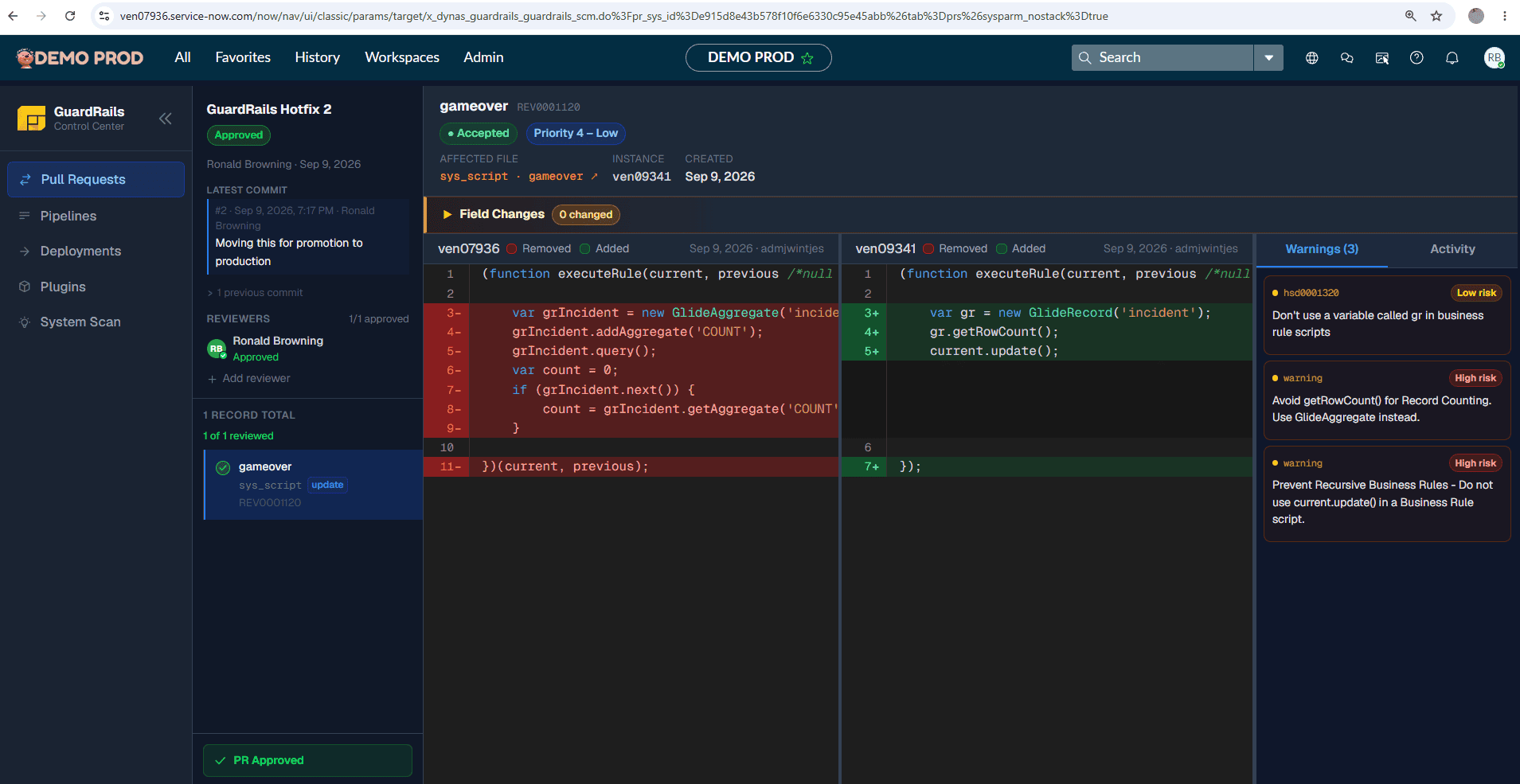
Watch Our Video
See Source Control Management in action in GuardRails.
2. Governed Review and Approval
Independent review is one of the most important mechanisms for reducing development risk and establishing accountability.
However, there is an important difference between conducting reviews and governing reviews.
A development team may routinely review changes while still lacking evidence that every applicable change received the required level of review.
Governed review establishes defined requirements around who can review changes, what must be reviewed, what approvals are required, and when those controls must occur.
For compliance purposes, organizations may also need evidence demonstrating:
- What was reviewed
- Who performed the review
- When the review occurred
- What decision was made
- Whether identified issues were addressed
- Whether required approvals occurred before release
It end goal is to ensure that review requirements become an enforceable and traceable part of the development lifecycle.
3. ServiceNow Release Governance and End-to-End Traceability
Development governance cannot end when code or configuration enters source control.
Organizations need to understand how a change progressed from its original requirement through development, testing, approval, release, and ultimately production.
Effective ServiceNow release governance creates a traceable chain between those activities.
Ideally, an organization should be able to follow a production change backward through its lifecycle as well as be able to follow the same change forward from its original authorization:
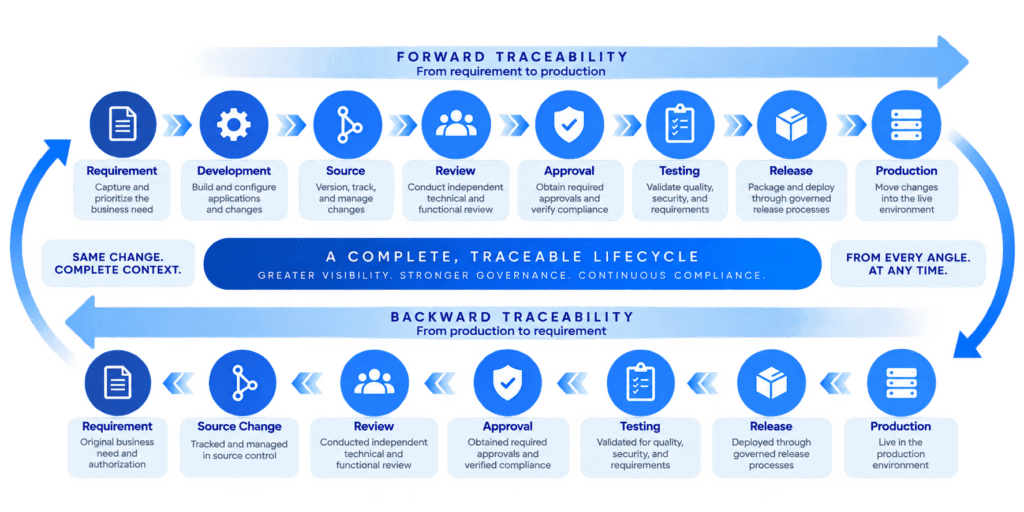
This end-to-end traceability supports more than regulatory compliance.
It can also improve:
- Audit readiness
- Release accountability
- Incident investigation
- Root-cause analysis
- Change-risk analysis
- Troubleshooting
- Operational resilience
Visibility alone, however, is not the same as traceability.
An organization may have extensive information distributed across multiple systems while still being unable to reconstruct a complete change lifecycle efficiently.
Effective release governance connects that evidence.
4. Segregation of Duties in ServiceNow Development and Deployment
Segregation of duties is a widely recognized governance principle designed to prevent a single individual from exercising incompatible levels of control over a sensitive process.
When applied to ServiceNow development, the principle is straightforward: An individual should not be able to independently create, approve, and deploy a sensitive change without appropriate oversight.
The practical implementation can vary according to an organization’s risk profile, operating model, and applicable compliance requirements.
However, the governance objective remains consistent: sensitive development and deployment activities should contain appropriate checks and balances.
This becomes more difficult as ServiceNow development scales across:
- Multiple internal development teams
- Distributed environments
- External development partners
- Citizen developers
- Low-code development
- Multiple release pipelines
- Automated deployment processes
Continuous governance can help make segregation of duties an enforceable characteristic of the development process rather than a control that depends exclusively on individuals remembering and following procedures.
5. AI-Assisted Development and AI Agent Governance
AI is introducing a new dimension to ServiceNow governance.
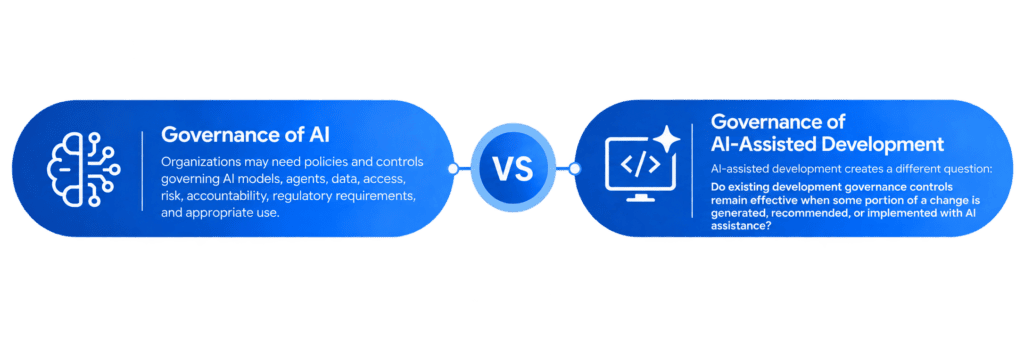
Organizations increasingly need to consider both governance of AI and governance of development performed with the assistance of AI. Both are related, but distinct, challenges.
Governance of AI
Organizations may need policies and controls governing AI models, agents, data, access, risk, accountability, regulatory requirements, and appropriate use.
Governance of AI-Assisted Development
AI-assisted development creates a different question:
Do existing development governance controls remain effective when some portion of a change is generated, recommended, or implemented with AI assistance?
The underlying compliance principles do not disappear simply because development becomes faster or more automated.
AI-assisted changes still need to be:
- Attributable
- Maintained in source control
- Independently reviewed where required
- Tested
- Approved
- Traceable to an authorized requirement
- Governed by appropriate segregation of duties
- Traceable through release and production
This makes AI governance an extension of the broader continuous governance challenge.
As development velocity increases, organizations need governance mechanisms capable of scaling with it.
Traditional Governance vs. Continuous Governance
Traditional ServiceNow governance frequently relies on people following documented processes. It happens on an ad-hoc basis, generally after a problem is encountered and has to be dealt with.
Continuous governance moves more of those controls directly into the development and release lifecycle itself, making it an embedded process that is always on and never stops.
Traditional Governance | Continuous Governance |
Documented policies | Enforceable controls |
Manual verification | Automated or integrated verification |
Periodic evidence collection | Continuous evidence generation |
Disconnected records | End-to-end traceability |
Manual compliance checks | Embedded compliance controls |
Audit preparation | Continuous audit readiness |
Reliance on process adherence | Demonstrable control enforcement |
Continuous governance does not eliminate people, policies, or judgment.
Instead, it reduces unnecessary dependence on manual compliance activities by making required controls a more integral part of how development work moves through the lifecycle.
The result is a governance model better suited to high-volume, distributed, and increasingly AI-assisted development.
From ServiceNow Governance Controls to Continuous Compliance
Organizations can have source control, peer review, testing, approvals, and segregation-of-duties policies and still struggle to demonstrate compliance.
The reason is simple: having a control does not prove that the control was consistently enforced.
Continuous compliance requires organizations to move beyond defining controls to enforcing them, maintaining traceability, and preserving evidence that demonstrates those controls operated as intended.
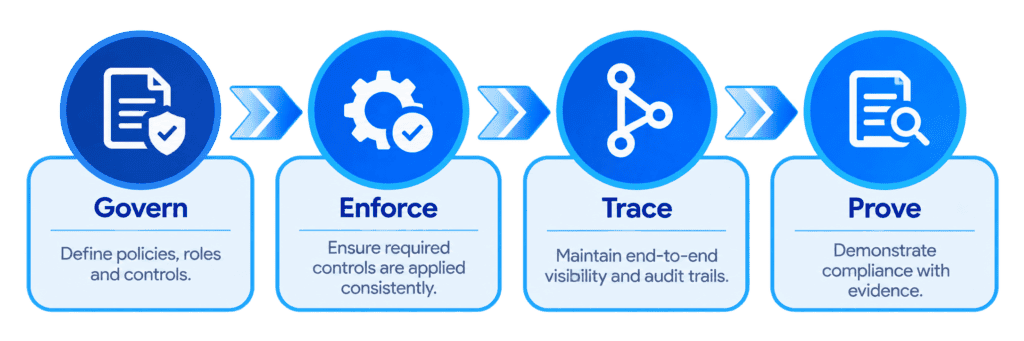
- Govern: Define the policies, responsibilities, and controls that apply to development.
- Enforce: Make required controls part of the development and release process rather than relying solely on voluntary adherence.
- Trace: Maintain the connections between requirements, development activity, reviews, approvals, tests, releases, and production changes.
- Prove: Retain reliable evidence demonstrating that required controls operated as intended.
This is the difference between simply having a governance framework and achieving demonstrable governance.
What Does an Audit-Ready ServiceNow Development Process Look Like?
Audit readiness should not require an organization to reconstruct its development history after the fact.
In an audit-ready environment, governance evidence is created as a natural result of development and release activities.
When an auditor evaluates an organization, they typically focus on several key areas, all of which rely on providing underlying evidence of review. An organization should be able to establish, where applicable:
- The authorized requirement behind a production change
- The complete development history
- Who performed the development work
- The applicable source-controlled changes
- Evidence of required independent review
- Evidence of required approvals
- Testing associated with the change
- Release and deployment history
- Appropriate segregation of duties
- The relationship between the approved change and what reached production
This is why continuous compliance differs fundamentally from periodic audit preparation.
Instead of asking teams to reconstruct evidence when an audit occurs, the governance process continuously creates and preserves the evidence needed to demonstrate compliance.
This is the difference between simply having a governance framework and achieving demonstrable governance.
ServiceNow Governance Maturity: From Manual Governance to Continuous Compliance
ServiceNow governance maturity is not determined simply by whether an organization has established compliance controls. A more meaningful measure is how consistently those controls operate, how deeply they are integrated into the development lifecycle, and how easily their effectiveness can be demonstrated.
As ServiceNow environments mature, governance typically progresses from manual, process-dependent controls toward more integrated, enforceable, and continuously evidenced governance.
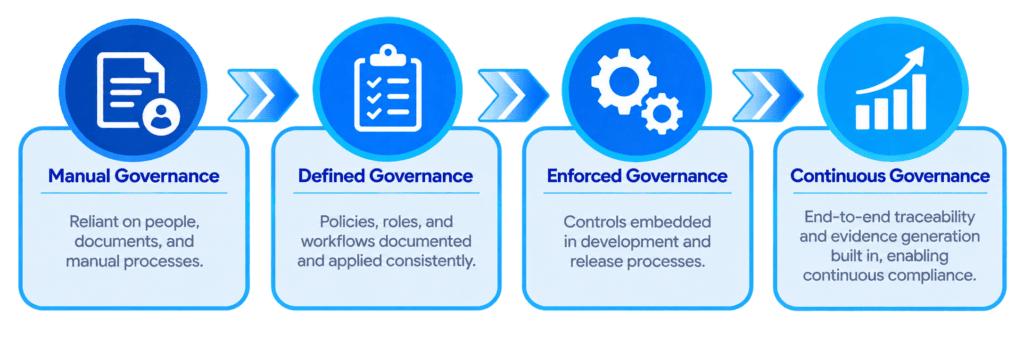
Manual Governance
Controls depend heavily on documented procedures, individual behavior, tickets, spreadsheets, emails, and manual evidence gathering. Governance may exist, but demonstrating that controls were consistently followed can require significant effort.
Defined Governance
Policies, responsibilities, workflows, and control expectations are documented and applied more consistently. Governance becomes repeatable, but enforcement and evidence collection may still depend heavily on manual processes.
Enforced Governance
Required controls are increasingly embedded into development and release processes. Source control, review, approval, segregation of duties, and traceability become harder to bypass, reducing dependence on voluntary process adherence.
Continuous Governance
Governance controls, end-to-end traceability, and evidence generation operate as an integrated part of the ServiceNow development lifecycle. Compliance evidence is created as work occurs, supporting continuous compliance and ongoing audit readiness.
The goal is not automation for the sake of automation, but rather to move from governance that depends on people remembering what to do to governance that is consistent, enforceable, traceable, and demonstrable.
ServiceNow Governance Best Practices
Organizations seeking to strengthen ServiceNow platform governance should consider several principles.
Action | Why? |
Treat source control as governance infrastructure, not simply a development tool. | A reliable development history is foundational to accountability, traceability, and audit evidence. |
Connect development activity to authorized business requirements. | A change is easier to govern when its origin, purpose, development history, review, and release can be traced. |
Make independent review demonstrable. | Don’t rely solely on the assumption that peer reviews occur. |
Build segregation of duties into development and release processes. | Sensitive changes should receive appropriate independent oversight. |
Preserve end-to-end release traceability. | Organizations should be able to reconstruct how an authorized requirement became a production change. |
Generate compliance evidence as work occurs. | Evidence created continuously is generally more reliable and scalable than evidence reconstructed for an audit. |
Apply governance principles to AI-assisted development. | Faster development should not mean weaker accountability. |
Automate controls where automation improves consistency. | Manual judgment will remain necessary in many situations, but routine governance requirements should not depend unnecessarily on memory or voluntary process adherence. |
Together, these practices move governance away from periodic compliance exercises and toward continuous control.
The Future of ServiceNow Governance is Continuous Compliance by Design
ServiceNow development is becoming faster, more distributed, and increasingly automated. Organizations are expanding the platform into more business-critical processes, low-code development is broadening participation, external partners are contributing to development, and AI-assisted development is accelerating the pace of change.
Governance needs to evolve with it.
The approach that needs to be take is not simply to add more manual gates, approvals, or audit procedures. It is to make appropriate governance controls an integrated part of how ServiceNow code changes are developed and released.
Source control provides an essential foundation by establishing accountability, version history, and a traceable record of development changes. But continuous compliance requires organizations to go further by connecting that development record to review, approval, testing, segregation of duties, release governance, and audit evidence across the lifecycle.
The end result of these efforts is continuous compliance by design, or governance that operates as development takes place rather than being reconstructed after the fact.
That means moving from:
Policies

Enforced Controls

Individual Records

End-to-End Traceability

Manual Evidence Gathering
Continuous Evidence Generation

Periodic Audit Preparation
Ongoing Audit Readiness
Assumed Compliance
Demonstrable Compliance
As ServiceNow environments continue to grow in scale, complexity, and development velocity, organizations that make this transition can strengthen governance without making governance an obstacle to innovation.
The future of ServiceNow governance is not more process, it is governance built into the development lifecycle that is continuous, traceable, enforceable, and demonstrable.
Putting Continuous Compliance into Practice
For many organizations, the practical starting point is establishing a reliable source-controlled development foundation and then extending governance across the processes surrounding it.
Solutions designed specifically for ServiceNow development governance can help bring these capabilities together. For example, Dyna Software GuardRails combines Source Control Management with governance capabilities designed to make development controls more consistent, traceable, and demonstrable across the ServiceNow development lifecycle.

Download Our Guide
Learn about Dyna Software’s GuardRails solution for platform governance and continuous compliance.
Other Resources
- GuardRails Product Page: Continuous Compliance and Platform Governance
- Read More: From Risk to Confidence, a Modern Governance Model for Enterprise ServiceNow Environments
- In the News: AI Raises the Stakes for Source Control in ServiceNow
- Blog: Why Dyna Software Added Source Control Management to GuardRails
Frequently Asked Questions
ServiceNow platform governance is the framework of policies, controls, processes, technologies, and responsibilities used to govern how the ServiceNow platform is developed, changed, tested, approved, released, and maintained.
ServiceNow compliance governance applies compliance requirements and controls to activities occurring across the ServiceNow platform and its development lifecycle. The objective is not only to establish controls but also to demonstrate that applicable controls were consistently followed.
ServiceNow GRC and IRM are generally concerned with managing organizational risk, policies, controls, compliance, and related governance activities. Platform governance focuses on governing changes to the ServiceNow platform itself, including development, review, approval, testing, release, and deployment. The two disciplines can complement one another.
Continuous compliance is an approach in which compliance controls, traceability, and evidence generation are integrated into ongoing development and release activities rather than being addressed primarily through periodic reviews or audit preparation.
Source control creates a structured history of development changes, including version history and change attribution. This provides an important foundation for accountability, traceability, review, and audit evidence. However, source control alone does not demonstrate that all required governance controls were followed.
ServiceNow release governance is the application of appropriate controls to how changes move from development through review, testing, approval, release, and production. Effective release governance helps maintain accountability and end-to-end traceability.
Segregation of duties helps ensure that an individual does not exercise inappropriate control over multiple sensitive stages of a change. Depending on the organization’s requirements, this may involve separating development, review, approval, and deployment responsibilities.
Audit readiness improves when development changes are source-controlled, linked to authorized requirements, independently reviewed where required, appropriately tested and approved, traceable through release and deployment, and supported by evidence generated throughout the lifecycle.
AI-assisted development should remain subject to appropriate development governance. Changes created or recommended with AI assistance may still need to be source-controlled, reviewed, tested, approved, attributable, and traceable through release into production.