




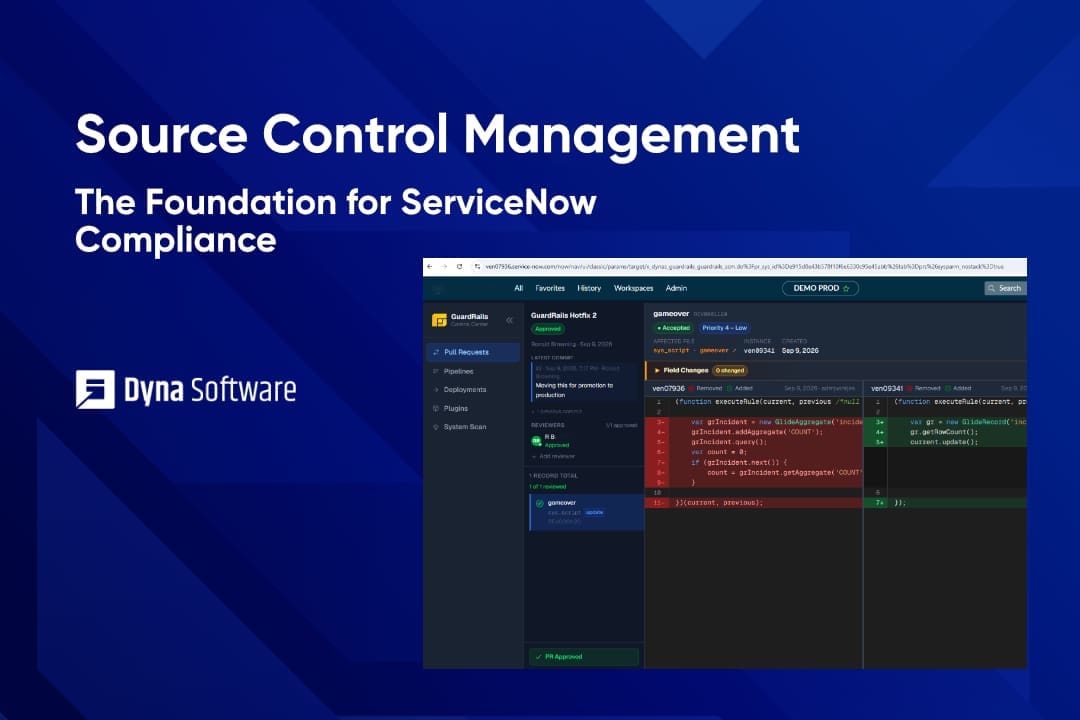
Why Dyna Software Added Source Control Management to GuardRails
ServiceNow development has changed dramatically over the years, from select use cases to a full enterprise platform that supports a large portfolio of apps, integrations and workflows. Today, ServiceNow development can span internal teams, external partners, citizen developers, and increasingly, AI-assisted development tools.
But in many cases, the processes used to govern all that development haven’t evolved at the same pace. Especially when it comes to regulatory compliance.
That’s one of the reasons Dyna Software added Source Control Management (SCM) to GuardRails.
SCM provides something fundamental to effective compliance governance, specifically objective evidence of what changed, who was responsible for changes, who reviewed and approved the change, and how it progressed into production.
SCM brings that discipline directly into ServiceNow by helping organizations enforce segregation of duties and controlled deployments while creating an auditable record that required governance controls were followed.
Why Manual ServiceNow Governance Doesn’t Scale
Manual governance may work when there are relatively few developers, applications, customizations, and releases. But as ServiceNow becomes more deeply embedded in the enterprise, the situation changes and becomes ultimately unmanageable.
More development teams create more changes, while more applications create more dependencies. Also, external partners and citizen developers expand the contributor base and faster release cycles leave less time for manual review.
Under those conditions, governance based on periodic reviews, manual checks, tribal knowledge, and post-development audits becomes difficult to scale and purely reactive.
A review performed after development may find a problem, but the organization has already incurred the cost of creating it. An audit may identify missing documentation, but it can’t retroactively create the governance discipline that should have produced it.
GuardRails takes a different approach by embedding governance into the development lifecycle so it happens continuously.
Policy enforcement, review, documentation, traceability, and evidence collection become part of normal ServiceNow development rather than activities performed after the work is done. That transforms governance from a manual and reactive exercise to a real-time, proactive control.
AI Creates Another Development Silo to Govern
AI adoption in the enterprise makes this shift even more urgent.
AI-assisted development can dramatically accelerate software creation, but faster development doesn’t eliminate the need for governance. AI-generated code, configurations, and integrations create another source of change entering ServiceNow.
Organizations still need to assess risk, determine whether changes meet development standards, ensure appropriate human review occurred, and establish accountability for what moves toward production.
AI can accelerate development, but accountability can’t be delegated to AI.
Without appropriate oversight, AI-generated development can enter ServiceNow without a clear understanding of risk, demonstrable human review, or appropriate safety measures. GuardRails’ added SCM capabilities provide the traceability and governance structure needed to make those controls demonstrable rather than assumed.
The principle is straightforward. As development becomes faster and more decentralized, governance needs to become more automated and continuous.
Why Source Control Management Is the Foundation
Effective governance begins with knowing exactly what happened.
You can’t establish accountability if you can’t attribute changes. You can’t demonstrate peer review or segregation of duties if those activities aren’t recorded. And reconstructing approvals after the fact is a poor substitute for generating evidence during development, or more importantly, an audit.
SCM establishes that foundation through traceability, structured reviews and approvals, and controlled development workflows.
It also connects development to deployment governance. Code must pass review before entering the deployment pipeline, with pull requests automatically triggering code reviews before code enters CI/CD. Built-in rollback and automated environment reconciliation and synchronization extend that control across the promotion process.
For ServiceNow platform owners, the bigger opportunity is to make compliance governance part of how development works instead of another process layered on top of it.
Source Control Is the Foundation, Not the Finish Line
SCM addresses a fundamental requirement for compliance governance. But governing a modern ServiceNow environment involves much more than maintaining an auditable change history.
Platform owners also need to know whether development is introducing technical debt, whether changes follow standards, whether upgrades could create conflicts, whether distributed teams and vendors are following the same rules, and whether the platform remains healthy.
That’s why SCM is part of a broader GuardRails governance model built around six complementary areas:
- Continuous Compliance and Audit: SCM, segregation of duties and traceability, reviews and approvals, activity logging, documentation, and monitoring.
- AI-Enabled Assistance: best-practice guidance informed by more than 30,000 known ServiceNow issues and product-related information, plus collision detection.
- Technical Debt Management: monitoring for technical debt, configuration drift, upgrade conflicts, roadmap alignment, and targeted fixes.
- System Scans and Forensics: system-level analysis, AI -powered recommendations, upgrade readiness, and plugin activation analysis.
- Platform Health: platform health and CSDM analysis, license monitoring, and plugin version monitoring.
- Code Deployment and Release Orchestration: CI/CD-ready automation, test integration, deployment alerts, pre-deployment validation, and rollback capabilities.
Together, these capabilities address the greater challenge of maintaining control over a ServiceNow environment that never stops changing.
Compliance Governance That Keeps Pace with ServiceNow
Today’s ServiceNow environments bear little resemblance to the smaller, more centralized implementations many organizations started with years ago.
Development is faster. Release cycles are shorter. More people and partners contribute. Applications are increasingly interconnected. And AI is becoming another participant in development.
Governance practices need to reflect that reality.
Source Control Management gives GuardRails a critical foundation by establishing objective evidence and a traceable system of record for ServiceNow development. Its broader value comes from what surrounds that foundation: continuous compliance and audit readiness, automated reviews, AI-assisted governance, technical debt management, platform health monitoring, and controlled deployment.
Ultimately, the aim is to make governance continuous, automated, and integrated enough to keep pace with innovation.
For ServiceNow platform owners, the correct shift is moving from periodically checks whether the platform is being governed to making governance an on-going, integral part of how the platform operates and evolves.
Watch the Demo Video
Watch our demo overview on the new Source Control Management capabilities in GuardRails
More Resources
- Visit the GuardRails Product Page
- Read the Press Release Announcement
- Download the GuardRails Datasheet